OSI & TCP/IP:-
- Computer network are made up of hetrogeneous software’s and hardware’s. In order to provide communication and inter operability between hetrogeneous networks models are defined.
- The network models are having number of layer which provides different services. Hence, there is a division of services in the hierarchical manner.
- More the number of layer better is the handling of services. Hence, expansion of models for large network is easy.
OSI(Open System Inter Connection) Reference Model:-
- It is a seven layer hierarchical and interconnection model to provide inter connectivity between hetrogeneous network.
- It was designed by ISO in reference to TCP/IP model hence, it is known as reference model.
- It is also called because it does not require licence to use this model.
The Seven Layers of OSI
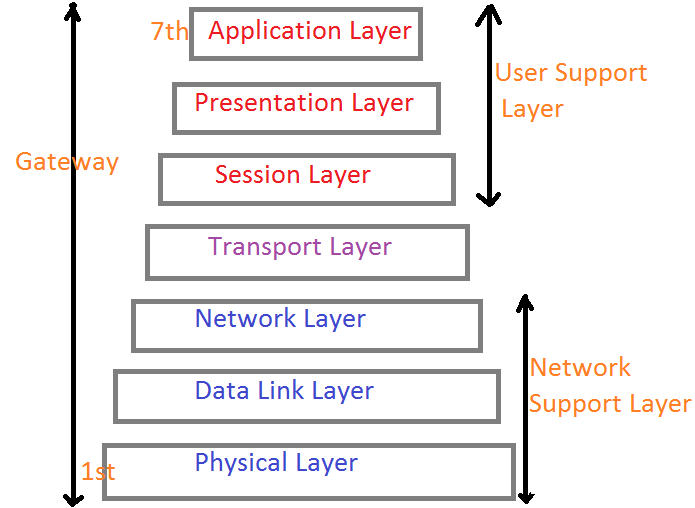
- Application layer and Physical layer do not attach any control information i.e header and trailer.
- Data Link Layer is the only layer which attach header as well as trailer. The trailer consists of CRC bits hence data link layer provides error control.
- Gateway which is used to control different types of network operating on different software is protocol converter which can operate on all the layer’s of OI and TCP/IP model.
User Support Layer:-
- The higher layer i.e Application, presentation & Session layer are known as user support layer because they help the user to access the services of network in particular time frame.
Note:- All layers are software in nature.
1) Application Layer:-
- Application layer allows the user to access the networks with the help of software like browser and various other application.
- # Services:-
- The application layer provides mail, services, file transfer services, Remote login services & directory services etc.
2) Presentation Layer:-
- it provides translation compression encryption and encoding.
- Translation means it converts the user friendly data to a common format which is understood by the network.
- # Compression:-
- It removes Redundant bit from the data and reduces its size.
- # Encryption & Encoding:-
- It makes the information secret by changing its format hence increases the security of user friendly data.

 Electronics Tutorial
nice…
LikeLike
good information to study….
LikeLike