#AM(amplitude modulation):-
In very simple words we can say that in amplitude modulation the amplitude of carrier signal is changes with respect to amplitude of the message signal.
For amplitude modulation modulation index is, m=AC/Am
Where, Ac- magnitude of the carrier signal
Am- magnitude of messages signal
#In case of amplitude modulation there are basically three conditions of modulation,
1.if modulation index m<1;-under modulation
2.if modulation index m=1;-critical modulation
3.if modulation index m>1;-over modulation.
Total power in amplitude modulation
P(total)=P(carrier) (1+m^2/2)
Where, P(carrier)=Ac^2/2
#FM(frequency modulation):- In frequency modulation frequency of the carrier signal changes with respect to the frequency of the message signal.
OR
*In telecommunication and signal processing frequency modulation (FM) is the encoding of information in a carrier by varying the instantaneous frequency of the wave.
In analog frequency modulation, such as FM radio broadcasting of an audio signal representing voice or music, the instantaneous frequency deviation, the difference between the frequency of the carrier and its center frequency, is proportional to the modulating signal.
fi=fc+Kf.m(t)
Where, Kf- frequency sensitivity
fi- instantaneous frequency
∆f=Kf(Am)
Where, ∆f- frequency deviation.
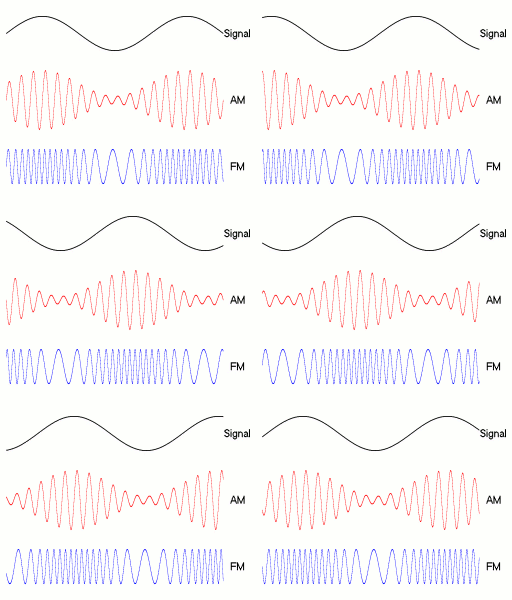
#Above GIF is perfect to understand the difference between AM and FM easily.
Thanks &Regards
Rahul Mishra

 Electronics Tutorial