- It is an application layer protocol which is used to access web pages from www.
- It is basically combination of two protocol FTP & SMTP.
- It uses the service of TCP at port number 80 which is for the transmitter of files hence it is reliable.
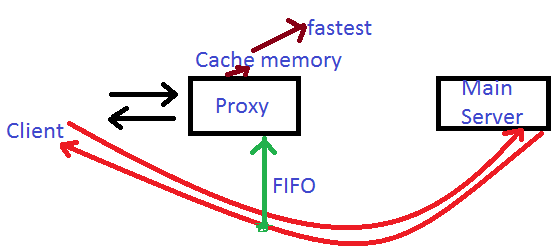
- It supports proxy servers which act on the half of main server.
- Proxy server keeps the copy of recent searches in its cache memory, Hence reduces the load of main server and improves the speed and efficiency.
- Cache memory is based on first in first out(FIFO) mechanism.
Simple Network Management Protocol(SNMP):–
- Network management includes the monitoring of the network and so take the remedial action.
- It consist of five FCAPS features.
F – Fault Management management C – Configuration management A – Accounting management P – Performance management S – Security management
F – Fault Management management :-
- Fault management is generation of alarms relate to faults, fault identifiers, diagnosis and rectification.
C – Configuration management:-
- It deals with the up gradation of link capacity, up gradation of various hardware and software depending on the requirement.
A – Accounting management:-
- It deals with the information produced by the server in a particular time period.
P – Performance management:-
- It deals with overall performance of the server link that is down time, number of errors, information availability time, delay in providing information, congestion or links etc.
S – Security management:-
- It deals with the security of the information and the attacks made over the server and vulnerability of the server and taking remedial actions like Firewall, Antivirus etc
Simple Network Management Protocol(SNMP):-
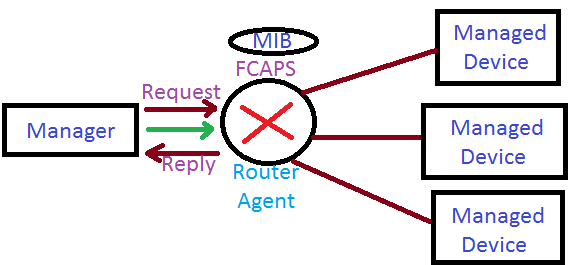
- SNMP is a network management protocol which based on the concept of request reply model in which manager request the network information from the agent i.e a Router.
- The agent creates the manage information database having the information related to FCAPS features of various managed devices.
NOTE:- SNMP takes the service of UDP to analyze these information on network management.
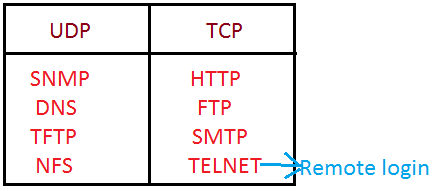
NOTE 1:- File transfer protocol(FTP), hyper text transfer protocol(HTTP), simple mail transfer protocol(SMTP), TELNET for remote login are used for TCP connection.
NOTE 2:- Simple network management protocol(SNMP), domain name server(DNS), trivial file transfer protocol(TFTP), network file system(NFS) uses the service of UDP.

 Electronics Tutorial