- Network topology is geometric representation of relationships of devices and links with each other.
- Types of network topology:-
- 1) Mesh 2) Bus 3) Ring 4) Star 5) Tree
1) Mesh Topology:-
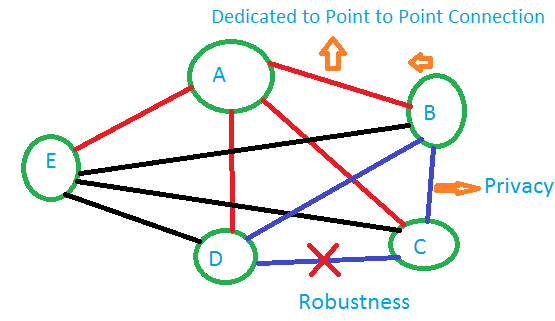
- In fully connected Mesh:-A→← B
- Number of wires connected =n-1+n-1+………………+n-1 = n(n-1).
- if wires are full duplex:- A →← B
- number of wires = n(n-1)/2
- Mesh is a dedicated point point topology. In which the Band width of the link is wasted but the security and privacy is high.
- In a full connected mesh the number of wires for connecting ‘n’ nodes is ‘n(n-1)’ and for fully connected full duplex connection the number of wires is ‘n(n-1)/2’. Hence, the number of wires are huge so the cost and complexity increases.
- Due to Point to Point connection if one link fail it does not incapacitated entire network hence, it is Robust.
- Fault detection is easy but correction is difficult.
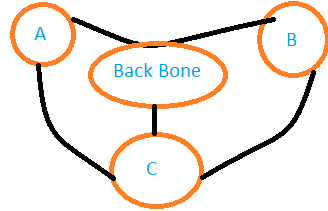
NOTE:- Back bones are used for providing inter-connectivity between different networks operate in mesh topology.
2. Bus Topology:-
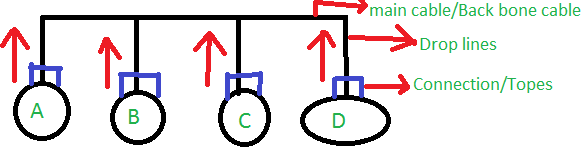
- Bus is multi-point topology in which the back bone cable is shared between number of devices. Hence, security is less and the cost of wiring is reduce.
- The information is broadcasted. Hence, not secure and if the back bone cable fail then the entire topology will fail.
- It is prone to signal reflections. Hence, the number of errors are more.
- If all devices will transmit together then there will be congestion so, Bus topology does not have traffic ,management due to this it not preferred large size networks.
NOTE:- Bus topology is used for LAN(Local Area Network).

 Electronics Tutorial