- LOSS:-
1)Attenuation loss:-
- Attenuation is defined as loss of signal strength or loss of signal power with
- The loss can occur due to Absorption of the signal and scattering of the signal.
- It is used to find out maximum signal strength to be used for particular transmission range.
- If maximum loss is known then maximum transmission distance can be calculated.
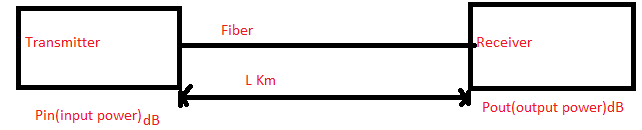
αL=(Pin-Pout) dB
Pin/Pout = (10)αL/10
Pout = Pin(10)-αL/10
A) Absorption Loss:-
- The absorption of the light depends on the presence of impurities due to faulty fabrication process and due to material used for fabrication of the Fiber.
- If the absorption is taking place due to the parent material of the fiber then it is known as intrinsic absorption.It is basically of two type.
i) UV Absorption ii) IR Absorption
i) UV Absorption:-
- It is caused by the valance electron of Silica which are ionized by the light.
- The ionization process involves absorption of light. Hence, Attenuation occurs
ii) IR Absorption:-
- The energy of light is absorbed by atoms of the Fiber material which results in to Mechanical Vibration of the Molecules.
Exterinsic Absorption:-
- It occurs due to presence of impurities which had enters in to the Fiber during the fabrication process.
- Example. O2 , Water, Air-Particle, Iron, Chromium etc.
- The light is absorbed by these impurities and the water has maximum absorption.
NOTE:- As the Wavelength increases the Extrinsic absorption reduces.

 Electronics Tutorial